
What you can see on the Chac Mool cam
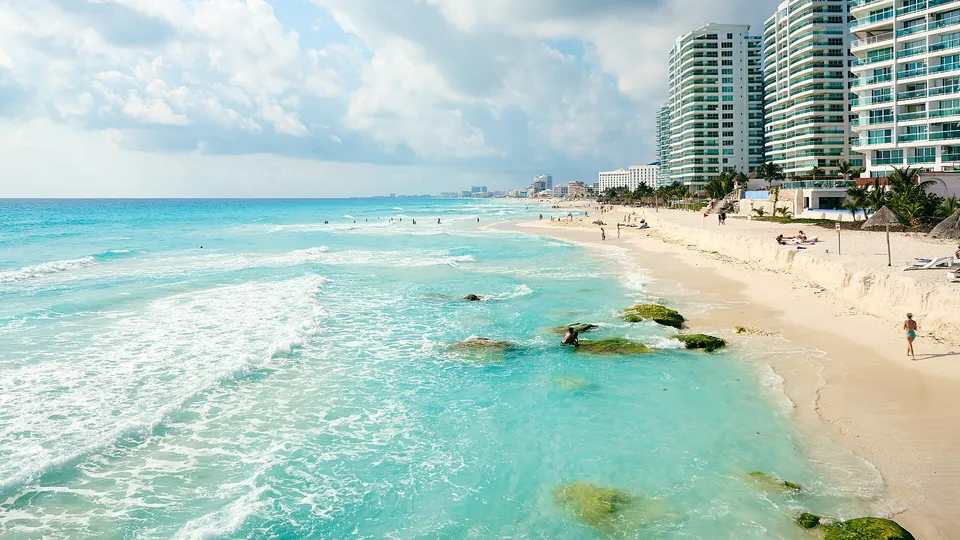
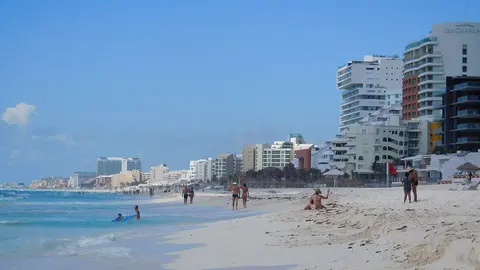
The view crosses a resort pool and its thatched palapas to the beach and the open sea. You can see the color of the water, the line where the waves break and how far the turquoise reaches before the sea turns deep blue. On windy days whitecaps show the trade winds blowing from the east straight onto this shore.
Why the water looks like this
The sand of the Mexican Caribbean is white because it comes from the reefs: it is made of broken coral and shells, which is also why it stays cool underfoot on hot days. Over that bright floor, shallow water absorbs the red part of sunlight and sends back the blue and green, and that is where the turquoise comes from. Over deeper water, seagrass or rock, it darkens.
The sand has not always been where it is now. In October 2005 Hurricane Wilma stripped much of the beach along this side of the hotel zone, leaving bare rock in places. Ships then pumped millions of cubic meters of sand back from the seabed to rebuild the beaches, and storms still move it from year to year.
When to watch Playa Chac Mool
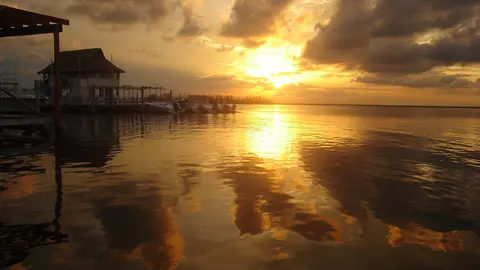
Facing east, the beach gets the sunrise over the sea, and the morning usually brings the calmest water. Around midday, with the sun high over that pale coral sand, the turquoise is at its most vivid, which makes it the best hour to see the colors explained above. Open to the east wind, this shore is one where sargassum can land, mostly between May and August, so the cam is worth a look before you set up for the day.
Nearby
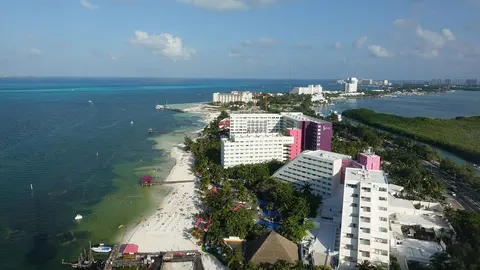
Playa Gaviota Azul is the same sand just to the north, at the corner of Punta Cancún, whose shopping centers, restaurants and clubs are a few minutes' walk away. Behind the boulevard lies the Nichupté Lagoon, with its mangroves and boat tours.
Getting there
A public path leads to the sand from Kukulcán Boulevard, between the buildings near Punta Cancún. This is open sea: read the flag on the lifeguard tower and swim close to it, because rip currents form here when the waves are up.