What you can see on the Akumal cams
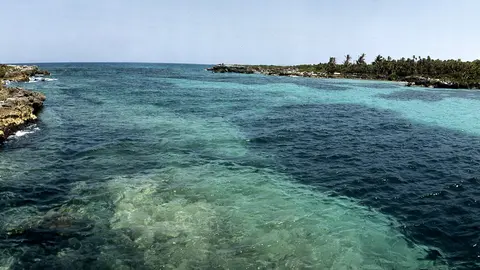
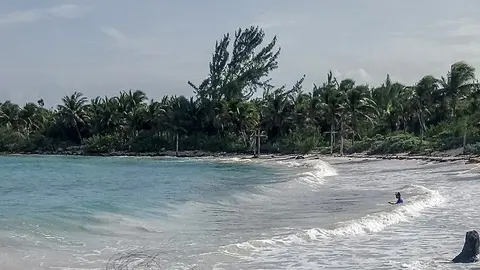
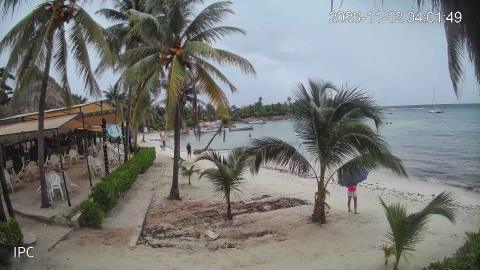
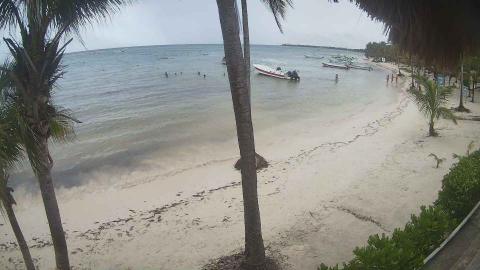
From the north side of the bay, the view looks through the palms past a beach bar to the reef line and the boats moored inside it. From the south side, it takes in the main beach, the boats and the shallow, pale water inside the reef. Between the two you can see how calm and clear the bay is and how many people are in it.
Akumal Bay from the north side
Looking through a stand of coconut palms, this camera watches Akumal Bay from its northern end. On the left is a beach restaurant under thatched roofs, with white tables and chairs; in front, a sandy path, low hedges and young palms; beyond them the sand curves away along the bay, with small boats moored in the calm water inside the reef and more buildings among the trees on the far shore.
The palms make it the best Akumal cam for judging the wind, and it shows how much weed has washed up along the sand. A local travel company streams both bay cams through ipcamlive, with its turtle logo in the corner.
Akumal Bay from the south end
From under the edge of a thatched roof at the other end of the bay, this camera looks out between palm trunks to the main beach and the water. The shallows run pale and clear a long way out, dotted with snorkelers in life vests, and a line of white boats lies moored on the bay; the beach curves away to the right, backed by palms.
This is the view for the water itself: how calm and clear it is, and how many people are out looking for the turtles. It comes from the same travel company as the north-side cam, through ipcamlive.
Turtles and seagrass
The floor of the bay is covered in seagrass meadows, the main food of adult green turtles, which feed here all year. Loggerheads and green turtles also nest on the beaches around Akumal, roughly from May to October. To protect them, Mexico declared Akumal Bay a refuge for protected species in 2016, covering turtles, corals and seagrass along about 11 km (7 miles) of coast. Akumal itself was born in 1958 as a base for divers, on the grounds of an old coconut plantation.
When to watch Akumal
The bay opens to the east, so the sun comes up behind the reef, straight in front of both cams. The first hour is the quietest in the water: the snorkelers have not arrived yet and the boats rest on their moorings. From midday the sun is behind the cams and lights the bay from above, so the dark patches of seagrass and the pale sand between them stand out most clearly. Since the turtles graze here in every month, there is no wrong season to look for them. What matters is the surface: when the wind ripples it, the view into the water is lost, and a smooth bay is the sign of a good day to snorkel.
Nearby
Just north of the main bay lie Half Moon Bay and the Yal-Ku lagoon, an inlet where fresh water from the ground meets the sea. Xpu-Ha's long beach is about 10 km (6 miles) north, and the inlet of Xel-Há about the same distance south.
Getting there
According to the Centro Ecológico Akumal, a guide is not required to snorkel, but a certified one, with an official ID, helps first-timers. Stay inside the bay and well back from the reef, keep at least 3 meters (10 feet) from any turtle, never touch or chase one, don't dive down, and wear a life jacket if you are not a strong swimmer. Use a rash guard or mineral sunscreen, and look at the flag before you wade in.